What Caldera is about
What makes it different
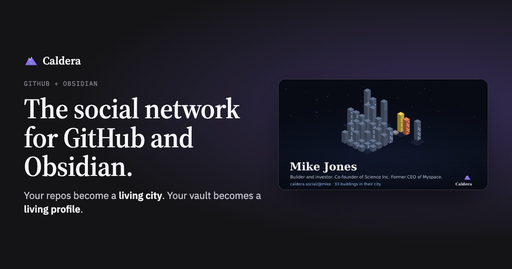
Caldera is the social network for GitHub and Obsidian, with two doors into one network. Come in with GitHub and your repos become a living city: districts are projects, buildings are repos, lit windows are this week's commits, site visitors drop in by parachute, and AI coding agents show up as drones over the repo they are working in. Come in with Obsidian and your vault becomes a living profile built on your own device: a flippable daily journal, an activity score, streaks and topics, refreshed every day. Plant notes in a Garden folder and each becomes a full public page with a license you choose, marked seedling, budding or evergreen, with links back and forth when you reference a friend's note. Notes can also be shared privately end-to-end encrypted, landing in the friend's vault as a normal note. Beyond profiles there are asks and offers with help-credit bounties, and instead of likes or downvotes you give 'gravity' to people who show up for you, which fades over a month so recent help counts most.
Caldera was built by Michael Jones (mjonesone), operator of mjonesone, LLC, whose maker profile on Product Hunt lists him as CEO. The pitch is a deliberate counterpoint to follower feeds: meet people by what they build and what they write, not by what they post. Instead of an app that ingests your notes into someone else's cloud, the Obsidian side builds your profile locally on your own device and only sends the finished page, and your identity is a cryptographic key that lives in your vault rather than a password. The whole thing runs on an open protocol and open-source code, so you can self-host your page or run your own hub.
There is no pricing page and no paid tier on the site: Caldera presents itself as free, open source and private by default. Privacy is structural rather than a promise — for GitHub it only reads repo names, languages and commit counts, never the files inside, and private repos appear only as unnamed padlocked buildings; the Obsidian plugin never uploads your vault, strips email addresses and phone numbers from gardens, and encrypts shared notes so the hub only stores ciphertext. One practical gate: your GitHub account must be at least 30 days old with a public repo or a follower, which keeps bots out. The GitHub side needs no install and rebuilds your page every 6 hours; the Obsidian side runs on Mac, Windows, Linux, iPhone and Android.
Growth timeline
More launches View all ›
 LooGo
LooGoFind public restrooms fast
Travel #108 Spiralens
Golden ratio camera that tells you where to move your phone
Photography #107CalderaYour Obsidian vault as a living profile and linked garden
Productivity #106 Emochi
Voice journal to understand yourself through art and science
Health #105 Draper
Validate, plan, and launch a business, one step at a time.
AI Tools